
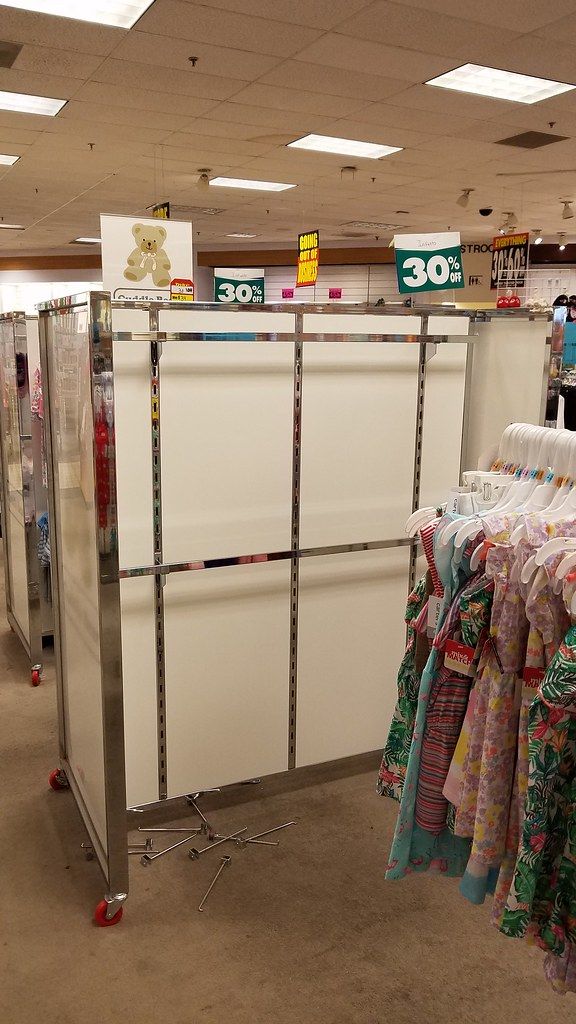
The most interesting real estate in retail right now isn’t being built — it’s being reborn. After a decade of department-store, big-box, drugstore and bank-branch closures, the sector’s smartest capital isn’t chasing ground-up development. It’s chasing the second life of buildings that already exist. As a broker who has spent 30+ years matching tenants to space, I’d argue adaptive reuse has quietly become the best story in retail real estate. Here’s why.
When a Big Box Goes Dark, the Real Estate Doesn’t
A vacated big box is not a dead asset — it’s a re-tenanting opportunity with great bones: high ceilings, deep floor plates, abundant parking, and a location that was underwritten for traffic in the first place. The wave of closures from Bed Bath & Beyond’s 2023 bankruptcy through more recent failures at Conn’s HomePlus, Big Lots and Joann has put thousands of these boxes back on the market — and operators are getting creative about what goes back in.
Consider Mission Viejo, California. Costco bought a former Bed Bath & Beyond on roughly seven acres for about $14.4 million and is converting it into the company’s first-ever stand-alone fuel station — 40 fueling positions, no warehouse attached. A box built to sell towels is being repurposed into a high-volume gas operation on an infill site that would be nearly impossible to entitle from scratch today.
Or take Fergus Falls, Minnesota, where a closed 90,000-square-foot Target became “Lincoln School,” an early-childhood education center. The district bought the building for about $1.5 million and finished the conversion for roughly $8 million total — about half the cost of new construction. The team even solved the windowless-interior problem with 49 tubular skylights. The point isn’t the daylighting; it’s the economics.
To convert a 90,000-SF former Target into a school — roughly half the $15M-plus cost of building new.
Owners Are Monetizing the Dirt Beneath Their Stores
The flip side of reuse is monetization. Retailers that own their real estate are increasingly looking at it the way an investor would — as capital they can unlock. RH (the former Restoration Hardware) has told investors it could generate as much as $500 million by monetizing its owned galleries, largely through sale-leasebacks, and even brought back the executive who architected its earlier sale-leaseback program to lead the effort.
But timing is everything in this game, and the math has gotten harder. RH completed sale-leasebacks years ago at cap rates in the 4%-to-5.5% range, when the 10-year Treasury sat below 1%. With benchmark rates now in the 4%-plus range, buyers demand materially higher cap rates — which means lower prices for the seller. That’s exactly why RH put a newer gallery on the market and struggled to hit its number. The lesson for any owner sitting on appreciated real estate: the asset is real, but the exit is a function of the rate environment, not just the rent.
The Math Is Why
Why is reuse winning? Three reasons I see on nearly every deal:
- Cost. Retrofitting second-generation space routinely runs a fraction of ground-up construction — the Fergus Falls conversion penciled around $150 a foot versus $250-$350 for new.
- Speed. An existing shell with existing utilities and an existing curb cut can open in roughly half the time of new development — and time is the most expensive line item in any project.
- Entitlements. The hardest thing to create in today’s market is a well-located site that’s already zoned, parked and built. You can’t manufacture infill. You can only re-tenant it.
What It Means If You Own or Invest in Retail
For landlords, the takeaway is to stop thinking of a dark anchor as a hole to fill with the same use that left. The most durable backfills I’m seeing — grocery, medical, fitness, value and off-price, even fuel and education — often have nothing to do with the prior tenant. For investors, second-generation space is where basis advantage lives: you’re buying proven locations below replacement cost, which is the single best protection against the next cycle. And for owner-occupiers, your real estate is a balance-sheet asset — just know that a sale-leaseback is priced off rates, so the window to monetize opens and closes.
The headlines will keep counting store closures. The opportunity is in what happens next to the building.
- Building Design+Construction, “Vacant Target store in Minnesota turned into early childhood education center.” Link
- Rethinking The Future, “Lincoln School by Solatube International.” Link
- C-Store Dive, “Costco to open first standalone gas station.” Link
- The Real Deal, “Costco grows Orange County footprint with new store, fuel center,” June 10, 2025. Link
- Fortune, “Costco is about to open its first stand-alone gas station,” June 16, 2025. Link
- RH Inc., Q4 FY2024 earnings call remarks (CEO Gary Friedman) on real estate monetization. Link

President & CEO, Schuckman Realty Inc.
Ken Schuckman is President & CEO of Schuckman Realty Inc., a retail-focused commercial real estate brokerage founded by Stanley Schuckman in 1978 in Hicksville, NY. With 30+ years of experience specializing in supermarket-anchored shopping centers, Ken is a CoStar Power Broker and member of X-Team Retail Advisors. He is also Co-Founder & Principal of BTF Capital Fund. SchuckmanRealty.com