
Category: Commercial Real Estate / Retail Trends
The “Corner of Happy and Healthy” is undergoing massive reconstructive surgery.
Three months after the private equity firm Sycamore Partners completed its acquisition of Walgreens Boots Alliance in August 2025, the strategy is becoming clear: this wasn’t just a retail acquisition; it was a massive real estate play.
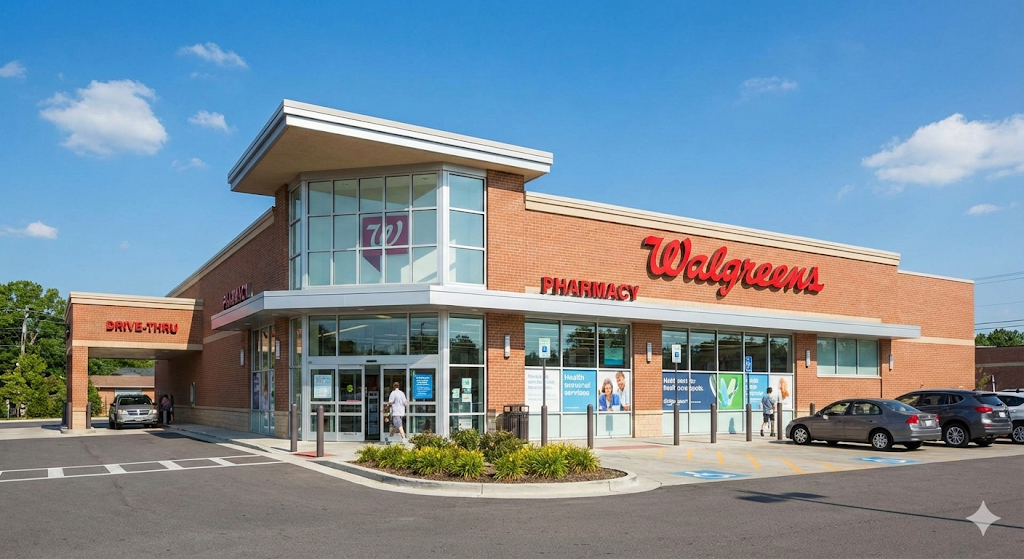
With Walgreens now a private entity, the fate of hundreds of prime corner locations across the United States is up in the air. As detailed in a recent report by the Commercial Observer, Sycamore holds the keys to a vast portfolio that requires urgent untangling from legacy debt and outdated lease structures.
Here is a deep dive into what is happening with the Walgreens portfolio, the challenges Sycamore faces, and what the future holds for these iconic corner lots.
1. The Motivation: Purchasing “Dirt” at a Discount
To understand the current strategy, you have to look at the numbers prior to the deal. In 2020, Walgreens boasted a market cap of roughly $80 billion. By the time Sycamore swooped in, that figure had cratered to less than $20 billion.
According to industry experts, Sycamore was largely driven by the underlying value of the real estate. While Walgreens only owns about 10% of its stores (having sold off 90% in sale-leaseback deals over the last decade), the control they have over the leaseholds is the leverage point.
The challenge? The “Legacy Lease” problem. Walgreens is burdened by 20- to 25-year leases signed during a different retail era—at rents that simply do not pencil out in the Amazon age. Sycamore’s goal is to reverse-engineer these assets to find value in the land and location, rather than the pharmacy sales.
2. The Great Repositioning: What Replaces a Walgreens?
With Walgreens planning to close up to 30% of its footprint, the market is about to be flooded with vacant boxes. However, these aren’t just any vacancies; they are hard corners with high visibility.
Sycamore is exploring several creative repositioning strategies:
• Mini-Grocery Stores: The physical footprint of a Walgreens is strikingly similar to that of a Trader Joe’s or the new “small-format” Whole Foods (7,000–14,000 sq. ft.). Developers view these shells as potential urban grocery hubs. The Catch: Suburban Walgreens often have limited parking that falls short of the strict requirements for high-volume grocers like Aldi or Trader Joe’s.
• Urgent Care & Medical: This is the path of least resistance. The infrastructure is already semi-medical, and with the “medtail” (medical retail) boom continuing into late 2025, these locations are prime targets for urgent care chains.
• The “Scrape and Rebuild” (QSRs): In some cases, the building is worth less than the ground lease. Investors are looking at underperforming stores, buying them at high cap rates (some seeing 11%), and planning to demolish the building to make way for high-volume Quick Service Restaurants (QSRs) like Chick-fil-A, Raising Cane’s, or Wawa.
3. The “Nuclear Option”: Bankruptcy and Lease Rejection
Sycamore Partners is known for turning around distressed retailers (such as their 2017 acquisition of Staples), and they are not afraid of aggressive tactics.
A major looming question is whether Sycamore will utilize Chapter 365 of the bankruptcy code. This legal maneuver allows a company to reject unexpired leases, effectively breaking the 20-year chains binding them to landlords.
• The Pro: It immediately sheds the cost of dead-weight stores.
• The Con: It is a “PR nightmare.” Walgreens is the second-largest pharmacy chain in the US. Aggressive bankruptcy maneuvers could invite government scrutiny and alienate the remaining customer base.
Sycamore is expected to separate the real estate assets from the retail operations to protect the brand while dealing with the property liabilities.
4. The Market Impact: A “Game of Chicken” with CVS
Walgreens isn’t suffering alone. CVS is also in the process of closing 1,000 locations. This has created a unique “Game of Chicken” in local markets.
As noted by Northmarq experts, if a town has a struggling Walgreens and a struggling CVS across the street, the winner is whoever stays open after the other blinks. If CVS closes, the surviving Walgreens absorbs that 30% of market share, potentially becoming profitable again.
5. Investor Outlook: Cap Rates on the Rise
For Net Lease (NNN) investors, the Walgreens instability has shifted the metrics significantly.
• 2022: Walgreens properties traded at roughly 5.75% cap rates.
• Late 2025: Cap rates have risen above 7%.
With roughly $2.5 billion in Walgreens assets currently for sale (representing 9% of all retail listings), it is officially a buyer’s market—but only for those with the stomach for risk.
The Bottom Line
Sycamore’s privatization of Walgreens marks the end of an era for the ubiquity of the corner pharmacy. For the commercial real estate world, the next 24 months will be defined by creative adaptive reuse. We are about to find out if a pharmacy can successfully morph into a grocery store, a gym, or a drive-thru, or if the debt burden is simply too high to overcome without court intervention.