
For three years the retail real estate story was subtraction — bankruptcies, dark anchors, and a running tally of square footage handed back to landlords. In 2026 the arithmetic has flipped. New-store openings are on pace to outrun closings for the first time since the pandemic, and the retailers doing the expanding are not building from the ground up. They are backfilling the very boxes their fallen competitors left behind. Scarcity of new construction has turned second-generation space into the most contested real estate in the sector.
Openings Overtake Closings
The directional shift is now measurable. Analysts at CoStar, Coresight Research, and Telsey Advisory Group project U.S. store openings to rise roughly 4% in 2026 — with estimates running in a 1.4% to 4% band — while closings decelerate by a comparable margin. That is a meaningful reversal after the 2025 wave that shuttered department stores and specialty chains.
The growth is concentrated, not broad. Off-price, beauty, discount, and value grocery are accelerating into vacated space, while luxury chains and traditional department stores keep contracting — Macy’s, Saks Global, and Francesca’s among the names still handing keys back. Demand also keeps skewing toward smaller footprints: units under 2,500 square feet now account for the bulk of new leasing activity. The winners of this cycle are the operators built for value and velocity.
Grocery Leads: Aldi’s 180-Store Year
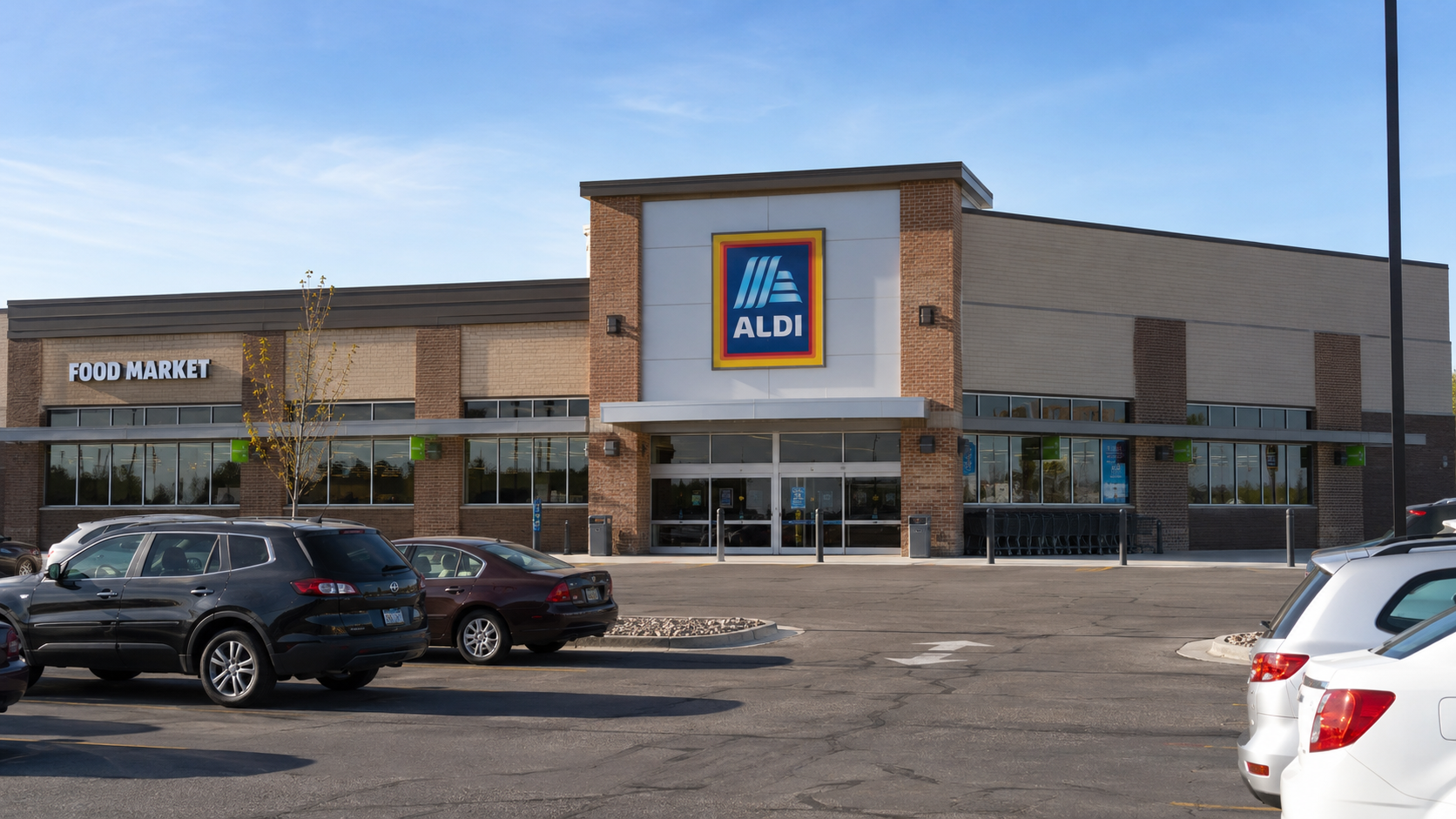
No single retailer illustrates the expansion story better than Aldi. Marking its 50th year in the United States, the discount grocer announced plans to open more than 180 new stores by the end of 2026 across 31 states — pushing its national footprint toward nearly 2,800 locations, a waypoint on the road to its stated goal of 3,200 stores by 2028.
The growth is geographic and opportunistic. Aldi will enter Maine this year, its 40th state, and has laid out a multi-year push into Colorado anchored by a new distribution center. Just as telling for landlords: the chain plans to convert roughly 80 former Southeastern Grocers storefronts to the Aldi format in 2026, with more than 200 conversions targeted by the end of 2027. That is second-generation grocery real estate being recycled at scale — existing boxes, existing infrastructure, faster to open than new construction.
Off-Price Recaptures the Big Box
If Aldi is the grocery headline, Burlington is the big-box one. The off-price retailer raised its fiscal 2026 target to 110 net new stores, and by its own account more than 40% of that new-store class is coming directly out of bankruptcy estates. The company has absorbed dozens of former Joann Fabrics leases, along with recaptured Bed Bath & Beyond and Big Lots boxes — space that would have sat dark for quarters in a weaker leasing market.
This is the mechanism worth watching. When a mid-box tenant fails, the lease doesn’t simply evaporate; it becomes inventory. Off-price operators like Burlington, Ross, and TJX have turned that inventory into their primary growth channel, underwriting recaptured boxes at rents and buildout costs that new construction cannot match. For owners of Class B power centers, a bankruptcy that once read as a crisis increasingly reads as a re-tenanting opportunity — if the box is the right size in the right corridor.
Second-Generation Grocery: Filling the Empty Shelves
The backfill dynamic is spreading into grocery’s own vacancies. As Amazon retrenches from physical grocery — winding down dozens of Amazon Fresh and Amazon Go locations — conventional and specialty grocers are stepping into the freed-up, already-built-out space. Notably, some of those Amazon boxes were never opened, leaving landlords with turnkey grocery infrastructure and a live tenant hunt. Grocers pursuing value and fresh-format growth have been quick to take assignment of those leases rather than wait years for a ground-up store.
For grocery-anchored center owners, the read is favorable: a deep, motivated bench of expanding grocers means shorter downtime on a vacated anchor and real competition for quality boxes — the opposite of the tenant-scarce environment that defined the last decade’s grocery shakeout.
The Capital-Markets Read
Backfill velocity is repricing the assets underneath it. Grocery-anchored centers are trading at national average cap rates in the high-6% range — roughly 6.7% — compressed about 40 basis points off the cycle peak, with institutional buyers underwriting stabilized product to the 5.5%–6.25% range. REIT bid volume for core grocery-anchored assets has surged, and with ground-up retail construction at multi-decade lows, the universe of quality product is effectively fixed.
That is the throughline connecting every story above. When almost no new retail is being built, occupancy is durable, re-tenanting is fast, and capital has nowhere cheaper to go, existing centers with the right anchors become scarce, cash-flowing, and bid. The tenants absorbing second-generation space are, in effect, underwriting the value of the landlords who own it.
What It Means for Owners
For anyone who owns or trades retail real estate, three practical conclusions follow from this cycle. First, a dark anchor is no longer a death sentence — the recapture market for grocery and mid-box space is the deepest it has been in years, and owners should be positioning vacated boxes to the active expanders, not marking them to zero. Second, right-sizing matters: the demand is concentrated in value formats and sub-2,500-square-foot inline units, so demising and reconfiguring can unlock more rent than holding out for a single legacy tenant. Third, price accordingly — with cap rates compressing and construction pipelines dry, well-anchored centers are worth defending and, where the basis is right, worth buying. The subtraction era is over. The operators who understand the backfill economy will own the next cycle.
- CRE Daily, “Retail Openings Edge Up as Closings Slow in 2026,” January 2026. credaily.com
- CoStar, “Store openings overtake closings as retail leasing normalizes,” 2026. costar.com
- ALDI US Newsroom, “ALDI US Doubles Down on Growth in 2026 with Plans to Open 180 New Stores,” January 12, 2026. corporate.aldi.us
- CNBC, “Aldi to open 180 U.S. stores in 2026 as shoppers seek value,” January 12, 2026. cnbc.com
- Fox Business, “Burlington plans 110 net new stores as part of fiscal year 2026 expansion,” 2026. foxbusiness.com
- Burlington Stores, Inc., Form 8-K / FY2026 results, U.S. Securities and Exchange Commission. sec.gov
- Grocery Dive, “Aldi to open 180 new stores in 2026 as part of major expansion,” January 2026. grocerydive.com
- ICSC, “11 Retail Real Estate Predictions for 2026,” 2026. icsc.com

Ken Schuckman is President & CEO of Schuckman Realty Inc., a retail-focused commercial real estate brokerage founded by Stanley Schuckman in 1978 in Hicksville, NY. With 30+ years of experience specializing in supermarket-anchored shopping centers, Ken is a CoStar Power Broker and member of X-Team Retail Advisors. He is also Co-Founder & Principal of BTF Capital Fund. SchuckmanRealty.com
© 2026 Schuckman Realty Inc. · Hicksville, NY · All rights reserved.