
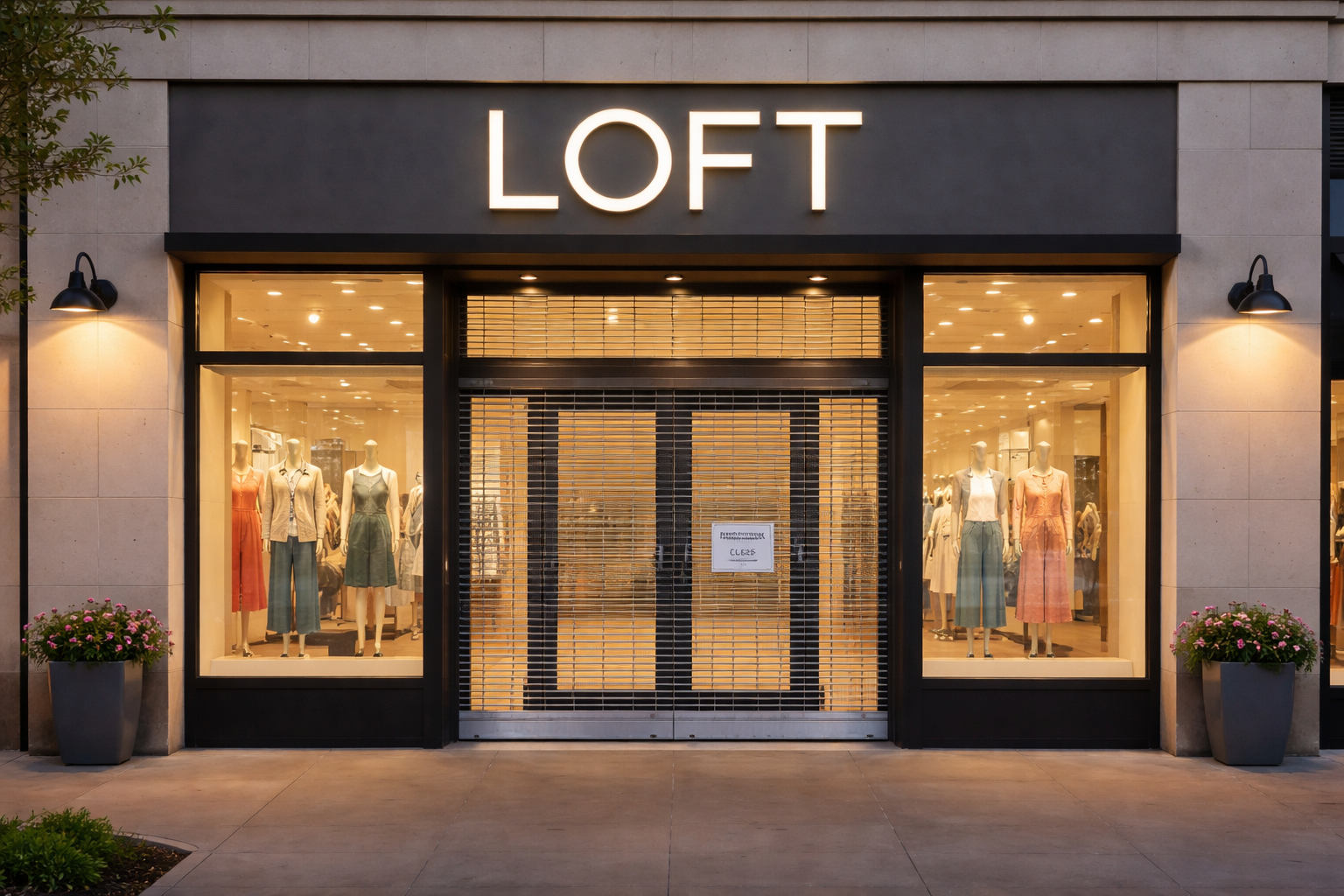
Every few weeks, another headline lands in my inbox warning that the mall is dying, the consumer is broken, and apparel retail is finished. Last week’s version came courtesy of TheStreet, which reported that KnitWell Group — the Sycamore Partners-owned platform that controls Ann Taylor, LOFT, Talbots, Chico’s, Lane Bryant, Soma, WHBM and Haven Well Within — is closing more stores in 2026.
After 30-plus years brokering and owning shopping centers across the New York metro, I’ve learned to read these stories differently than most people do. Here’s my take: this isn’t a crisis. It’s a rotation. And if you own the right kind of real estate, it’s an opportunity.
What’s actually happening
Let’s start with the facts. KnitWell has confirmed a handful of selective 2026 closures so far — a LOFT in Durham, North Carolina and another in Whitehall Township, Pennsylvania; an Ann Taylor in Naples, Florida; a Chico’s in Overland Park, Kansas; a Talbots in Short Pump, Virginia. Tellingly, at least one of those LOFT closures was attributed not to bankruptcy or distress, but to a decision not to renew the lease.
That distinction matters. A lease non-renewal is a real estate decision, not a corporate death rattle. KnitWell still operates roughly 3,000 stores. The platform was assembled out of the ashes of Ascena Retail Group’s 2020 Chapter 11 — Sycamore Partners bought the Ann Taylor and LOFT brands for $540 million, a fraction of the $2.16 billion Ascena paid in 2015 — and rolled them into KnitWell in 2023. Private equity didn’t buy this portfolio to grow the store count. They bought it to optimize margin, harvest cash flow, and right-size the footprint to whatever number of stores actually makes money in 2026.
A lease non-renewal is a real estate decision, not a corporate death rattle. The question isn’t whether KnitWell is closing stores. It’s which stores — and why.
The pattern under the headlines
Look at the closure list again. Suburban C-mall and second-tier lifestyle center addresses, almost universally. You won’t find KnitWell pulling out of a Manhasset, a Garden City, a Roosevelt Field, or a Whitestone. You’ll find them rationalizing the bottom 5–10% of their footprint — the locations where the math stopped working three lease cycles ago and the only thing keeping the store open was an option Sycamore inherited.
CoreSight reported that retailers announced 67% more store closures in 2025 than in 2024. That sounds catastrophic until you remember that the same period has produced record net absorption in grocery-anchored centers, the lowest available retail vacancy in over a decade, and rents in the best New York metro centers that are at all-time highs. Both things are true at once. The bad real estate is getting worse. The good real estate is getting better. The middle is disappearing.
Why landlords on the right side of this trade should be smiling
If you own a healthy shopping center anchored by a grocer that’s actually selling food — not a relic supermarket banner trading on nostalgia — the KnitWell closures and the broader apparel pruning create three things you want:
1. Below-market boxes coming back at market
Most of these legacy apparel leases were signed at rents that haven’t been touched in 10–15 years. When a 4,500-square-foot LOFT or Ann Taylor recaptures, the replacement deal is almost always at a meaningfully higher rent — and often with a stronger credit tenant in a category that wasn’t competing for inline space a decade ago.
2. A backfill bench that’s actually deep
Five years ago, replacing an apparel inline tenant was painful. Today, the line of credit-quality users chasing 3,000–6,000 square feet in a well-located, grocery-anchored center is the longest I’ve seen in my career. Boutique fitness — Pvolve, [solidcore], StretchLab, Club Pilates — keeps expanding. Med spa and aesthetics operators are paying real rent. Athleisure brands like Vuori and Alo Yoga want exactly this footprint. So do the new wave of beauty concepts, quick-casual restaurants, and even healthcare users who finally figured out that retail real estate works for patient acquisition.
3. A merchandising upgrade
Honestly? Replacing a tired Talbots with a Sephora-adjacent beauty concept or a high-volume fitness studio isn’t a downgrade for the center. It’s a traffic generator. The customer who stopped coming for Talbots is replaced by a customer who comes three times a week and brings two friends. That’s a co-tenancy story your other tenants will pay you for at renewal.
Where the risk really is
I don’t want to sound Pollyannaish. There is real pain in this market — it’s just concentrated very differently than the headlines suggest. The risk isn’t with the KnitWell brands closing a handful of stores. The risk is with enclosed B- and C-mall owners who are still pretending the 2010 leasing playbook works, and with secondary-market power centers where the grocery anchor is weak, the parking field is too big, and the inline tenants are all in the same demographic crosshairs.
If you own that real estate, the KnitWell closures are a warning shot, and there will be more. Macy’s announced last year that it would shutter roughly 150 stores by the end of 2026. Nordstrom is closing full-line stores in markets like Dallas and Delaware. Foot Locker is taking its mall-based footprint down by 400 units. Eddie Bauer just liquidated. The pattern is unmistakable: whatever can’t survive in a B- or C-mall environment is finally being put out of its misery, and the closure pace will accelerate before it slows down.
My advice to fellow landlords and operators
Three things, in order of urgency:
First, audit your KnitWell exposure now. Pull every Ann Taylor, LOFT, Talbots, Chico’s, Lane Bryant, Soma, WHBM and Haven Well Within lease in your portfolio. Map the expirations. Identify which ones are below market and which ones are at risk of non-renewal. Don’t wait until the nine-month notice window — start the backfill conversation today.
Second, refresh your prospect list. The replacement tenants for these boxes look nothing like they did five years ago. If your leasing team is still cold-calling apparel brands, you’re fishing in the wrong pond. Get your broker working the boutique fitness, beauty, athleisure, healthcare, and food-and-beverage prospect universe.
Third, stop apologizing for owning brick-and-mortar. The narrative that physical retail is dying is now empirically wrong, and has been for at least three years. Grocery-anchored shopping centers are arguably the best-performing institutional real estate asset class in the country right now. The capital is voting with its feet. The tenants are voting with theirs. Don’t let a clickbait headline about a store closure in Whitehall, Pennsylvania convince you otherwise.
The bottom line
KnitWell Group isn’t collapsing. It’s rationalizing — and the locations being rationalized are exactly the ones that should have come back to landlords years ago. If those boxes are in your center, congratulations: you’re about to mark a piece of real estate to market for the first time in a decade. If they’re not, the lesson is the same one this business has been teaching for forty years: location, anchor quality, and trade area discipline always win in the end.
The retail apocalypse has been ten years away for the last twenty years. I’ll bet on the right shopping center every single time.
Sources
- TheStreet, “72-year-old mall retailer to close more stores in 2026,” April 3, 2026. thestreet.com
- TheStreet, “125-year-old retail chain to close more stores in 2026” (Nordstrom), March 31, 2026. thestreet.com
- TheStreet, “48-year-old nostalgic mall retailer will close 25 stores in 2026” (Zumiez), March 31, 2026. thestreet.com
- CoreSight Research, U.S. Store Openings and Closures Tracker, 2025 annual data.
- McKinsey & Company, “The State of Fashion 2026” report.
- Business Insider coverage of Ascena Retail Group Chapter 11 (2020) and subsequent Sycamore Partners acquisition.
|
Ken SchuckmanPresident, Schuckman Realty Inc. Ken Schuckman is President of Schuckman Realty Inc., a retail-focused commercial real estate brokerage founded by Stanley Schuckman in 1978. With 30+ years of experience specializing in supermarket-anchored shopping centers across the New York metro, Ken is a CoStar Power Broker and member of X-Team Retail Advisors. He is also Co-Founder & Principal of BTF Capital Fund. Learn more at SchuckmanRealty.com. |